

The Speedmaster is a Psy-Op
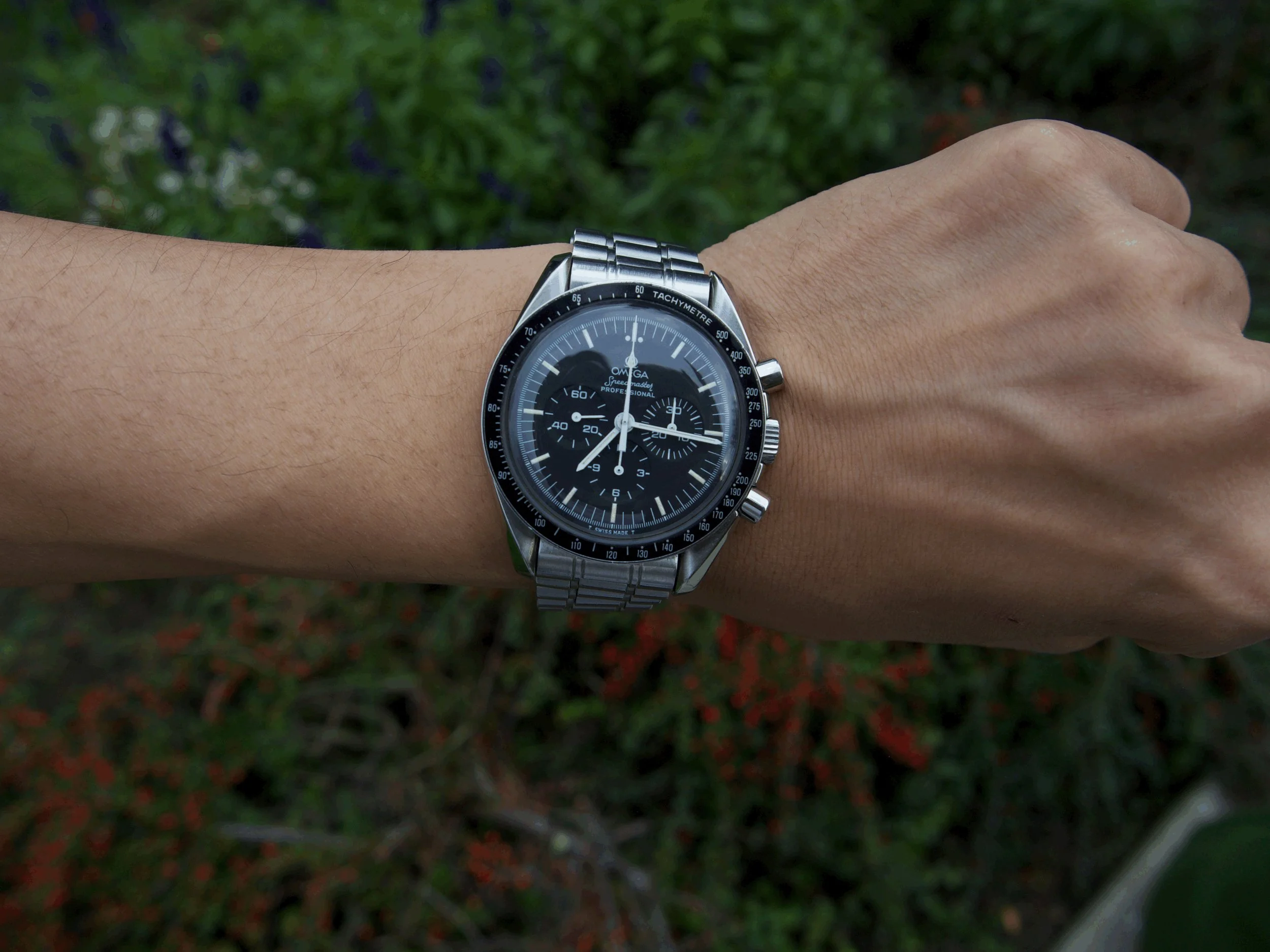
145.022
I have a confession. I own a Speedmaster, and I like it more than any reasonable accounting of its specs would justify. If I hated the thing, this would be an easy piece to write. Just another entry in the long tradition of people complaining that the Moonwatch is overrated on WUS at 2am. I could point at the bracelet, complain about the case thickness, and act like I'd personally uncovered something the entire watch industry missed. But every single time I actually wear mine, I think it's a genuinely good watch, and that's what makes this whole argument so annoying to make. The Speedmaster is good. That's the problem!
You're going to have to sit with that tension along with me for the next two thousand words, sorry.
Somewhere along the way in the hobby, owning one turned into a requirement of some sort. You could dodge it for a while before someone asks whether you have one. Nobody asks if you like chronographs, or enjoy winding a watch by hand, or whether a Moonwatch case fits the collection you're building. The recommendation just shows up, fully formed, completely independent of anything you've said about your own taste, seeing that at some point the Speedmaster stopped needing your taste to earn its spot on the list.
You're probably wondering how it got that kind of pull, and fair enough, as the usual defense people reach for (the history) happens to be genuinely extraordinary, which is annoying if you were hoping to dunk on it. The Speedmaster launched in 1957 as a sporting chronograph built for motorsport and professional timing with no cosmic ambitions attached, just a solid tool watch doing tool watch things. NASA tested a batch of chronographs under duress years later, the Speedmaster passed, astronauts wore it, and Apollo gave a perfectly good tool watch.
You can market that story aggressively, but the underlying event still actually happened. Say the phrase 'the first watch worn on the moon' out loud right now and notice how little friction it produces. It's been repeated so often that it started functioning as a line item on the spec sheet, right next to the caliber number and the water resistance rating.
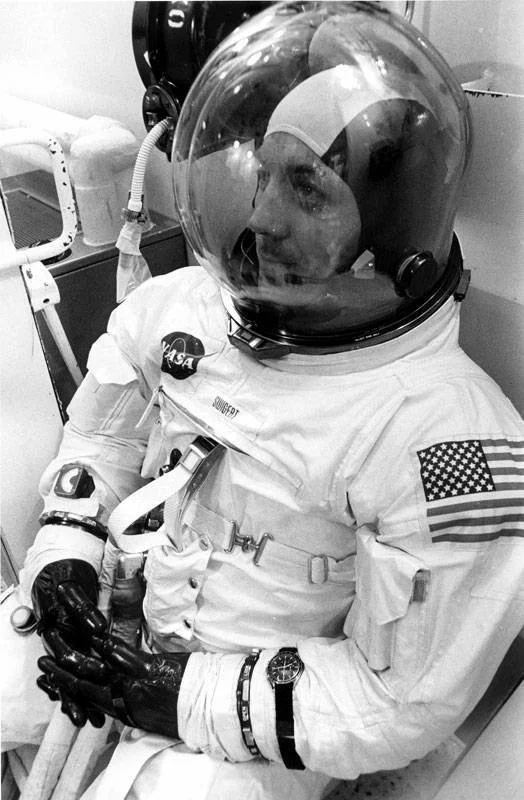
Image: NASA
Ironically, Apollo 13 does more emotional lifting than the landing itself. A Speedmaster on Jack Swigert's wrist got used to time a critical fourteen-second engine burn by hand after an oxygen tank failure knocked out the spacecraft's instrumentation, manual timing that helped bring three astronauts home alive. Omega gave the watch its own medal for this and built a sub-collection around retelling the story every few years. Watch the slide happen, though. A watch built for astronauts gets credited, reasonably, with contributing to a rescue, and the credit drifts from 'useful backup instrument' to 'the watch that saved the mission.' The watch kept excellent time while it happened, which is exactly what it was built to do.
This is probably why the watch gets away with so much, if I'm honest. The same black dial, the same three subdials, the same tachymeter bezel that have stared back at collectors for decades still manage to feel important on sight, given that the design just has its own context with it wherever it goes. You don't have to explain why the dial looks the way it does or why the bezel is there, since thousands of people have already written that essay for you, several of them badly.

Let's talk about money for a second, on the grounds that the numbers here refuse to add up in a way that should bother you more than it does. A Speedmaster Professional could be bought for a few hundred dollars for most of its production history, a genuine tool watch priced like one, worn by working engineers and test pilots who were absolutely not thinking of it as an investment vehicle at the time. The current Hesalite Moonwatch now starts north of seven thousand dollars (current retail runs about $7,200, per Omega's own listing), and that's just the entry point into a lineup that keeps climbing into the tens of thousands from there.
The Caliber 3861 is a fine movement, but movements this capable exist elsewhere in the market for a fraction of the price. What actually appreciated over that span was the value of the story attached to it, compounding year over year the way a good piece of intellectual property compounds, until the mythology itself became the single most expensive component sitting inside the case, a suspiciously well-preserved sixty-year-old asset with zero maintenance costs.
Then, the MoonSwatch takes the Speedmaster's silhouette, drops the price to around $260. It caused actual crowds outside stores on launch day in 2022, and resale prices spiked past $1,000 within hours. Four years later, Swatch is still finding new angles on the same trick. This year's Mission to the Moon 1969 edition adds real 18-karat gold to the dial and pushers, prices it at $570, and hands out access through an online application process modeled loosely on a US travel visa system.
That consensus extends into who gets to recommend the watch, and this is where the hobby's stated values look thin. Collecting spends enormous energy insisting on individuality while maintaining unusually strong agreement about what individual taste is supposed to land on. Tell someone to buy what they love, hand them a list of watches they'll probably love, and the Speedmaster is reliably near the top, the safe answer for someone who wants to care about watches without caring too much. Rolex can feel too obvious, Patek too out of reach, an independent too much to explain. The Speedmaster sits in the middle, recognisable enough to matter and enthusiast-credible enough to avoid looking like plain luxury. From my own experience, you cannot embarrass yourself wearing one anywhere, and that social safety might be its single greatest achievement.
I've started wondering (and you should too) honestly, whether we've mistaken all that versatility for actual personality. The Speedmaster is extraordinarily flexible, sure, but flexibility isn't the same quality as character, whatever your group chat tells you. Sometimes a watch earns real attachment exactly because it's a little inconvenient, a case too thin for practical water resistance, a dial that's a bit strange, a movement nobody strictly needed, something too small or too formal or too weird for the person wearing it to fully explain at a dinner party.
That's why the whole 'perfect first luxury watch' conversation always strikes me as a little funny, if you think about it for more than a minute. The Speedmaster gets positioned as the answer to a problem most new collectors didn't actually have, some imagined future where the watch needs to cover every possible version of the life they might eventually live. You might get deeper into watches. You might lose interest entirely. You might start wearing suits, or develop a sudden fascination with vintage chronographs you can't afford yet. The Speedmaster has you covered regardless, which makes it something close to the horological equivalent of a navy blazer someone told you every collector needs. This is where the difference between collecting and optimising actually starts to matter. A lot of modern collecting seems built around assembling the most defensible collection, the watch with the best history, the strongest finishing, the widest social approval, and the Speedmaster satisfies that checklist with almost unnerving efficiency. That's not a knock on the watch itself, which really does reward years of study through vintage references and reference-number rabbit holes deep enough to lose a weekend in.
That same willingness to look past the flaws shows up somewhere else too, in how oddly hard it is to just dislike this watch without feeling faintly unreasonable about it, which is a strange amount of social pressure to feel about a chronograph. Plenty of people dislike chronographs, manual winding, the bracelet, the proportions, and any one of those is a perfectly ordinary reaction to have toward an object you're not required to like. But say that out loud to another collector and you'll often find yourself explaining the decision anyway, defending an absence rather than simply stating a preference, the way you'd defend skipping a family wedding rather than just, you know, not going. Passing on the Speedmaster somehow requires an explanation in a way passing on most other watches never does, and that alone, more than the price or the history, might be the clearest evidence that something engineered is operating underneath all this affection.
This is usually where a piece like this pivots toward some tidy resolution, and I genuinely still don't have one for you, so the watch really is that good independent of all the mythology I just spent two thousand words unpacking. The Caliber 3861 is a genuinely well-engineered column-wheel chronograph movement, full stop, no asterisk. The hesalite crystal on the Professional model is a defensible, almost stubborn design choice in an era where everything else gets upgraded to sapphire, and I like the small rebellion of a brand refusing to modernise a detail purely because tradition asked it not to. The watch would still be a genuinely excellent chronograph even if Buzz Aldrin had somehow worn a Rolex up there instead. The moon story just happens to be true, though, and that's exactly why it works this well on people like me. A community that prides itself on research tends to eventually pick apart a fabricated mythology, no matter how good the marketing team is, which makes the fact that this one keeps holding up genuinely worth noting. Retold at exactly the right moments for six decades running, it becomes something closer to load-bearing infrastructure at this point, and I don't think there's a version of loving this watch that doesn't also mean loving the story a little more than the watch strictly deserves on mechanical merit alone.
None of this is unique to the Speedmaster, either, if it makes you feel any better about your own collection. I've bought watches before because I understood why they were supposed to matter, read enough about a reference that I eventually appreciated it simply through sheer familiarity with the arguments circling around it, the same way you eventually start liking a song after your friend plays it forty times. That's a totally normal part of how taste develops. What watch culture sometimes pretends, though, is that taste develops in a vacuum, completely uninfluenced, entirely self-generated, and the Speedmaster is such an effective test case so it makes personal discovery feel available even though millions of people have already walked the identical path before you got there. That doesn't make the affection fake, but it is worth actually looking at directly instead of taking entirely at face value, which is, I suppose, the whole point of this piece you've stuck with me through.
