

Versions of Abject: Ugly Watches
There is no gentle way to enter the topic of ‘ugly’ watches. Collecting culture performs a careful choreography around taste, yet at the centre of it lies a truth widely sensed but rarely spoken. Some watches are ugly in ways that become cherished. Others are ugly in ways that are politely endured. A third category is ugly in ways that attract no forgiveness or narrative salvage. Taste is not a neutral appraisal, as collectors often claim. Taste is a system of cultural permission. A watch is only as ugly as the group allows it to be.
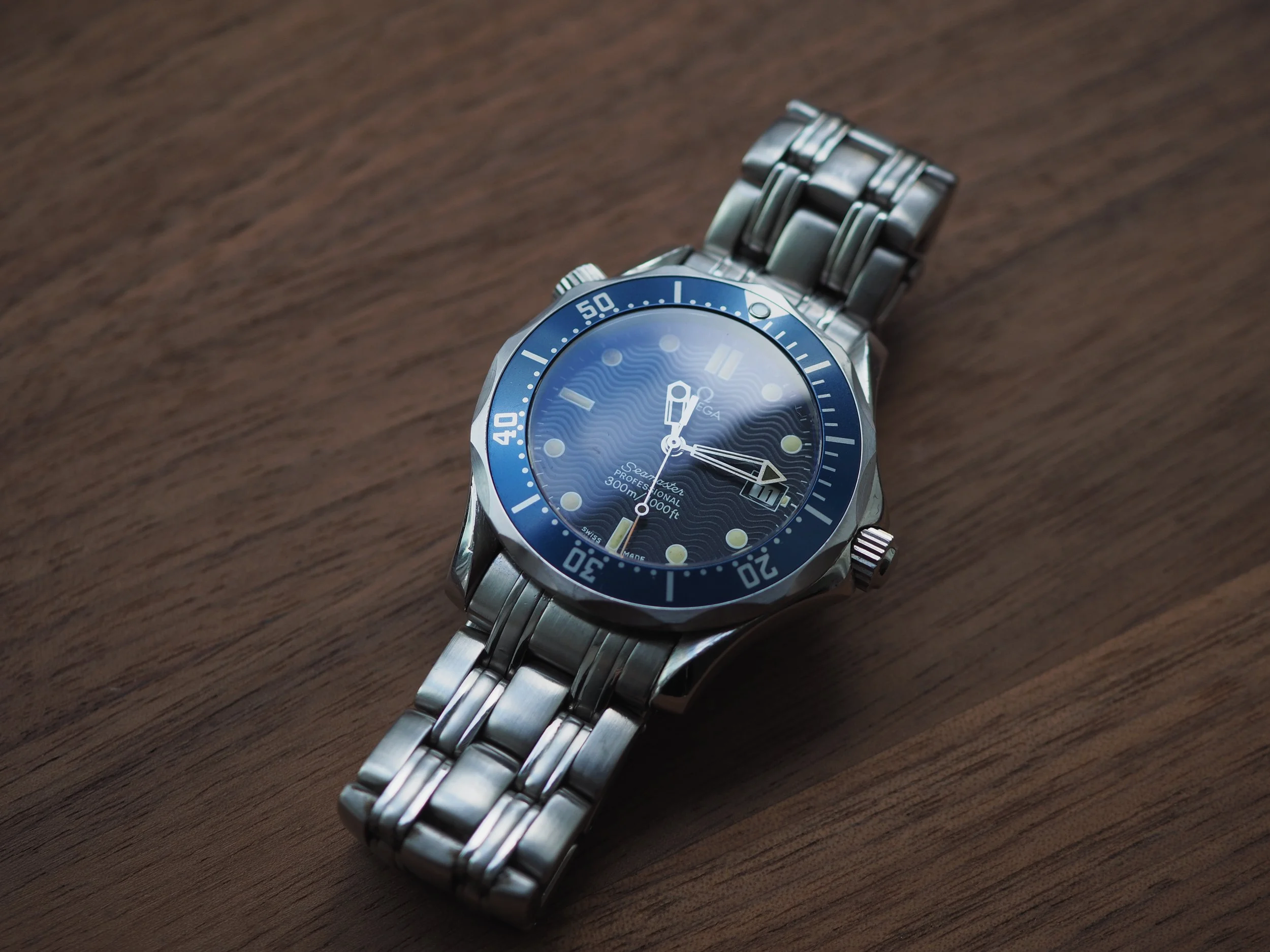
The often-lauded neo-vintage Omega Seamaster 300 demonstrates this clearly. By any measured standard it is a conflicted object. The bezel scalloping is aggressive, disrupting the circular harmony of the case. The skeleton hands crowd the dial. The wave pattern reads as decorative rather than purposeful. The helium escape valve interrupts the profile without compositional logic. A young microbrand producing the same layout today would likely be dismissed as unfocused. Yet the SMP 300 has been absorbed into a canon of affection. Its flaws have been reinterpreted as charm. Collectors describe it as cinematic. They reference Bond. They reference an era when design risk was normal rather than strategic. The watch has been forgiven into cultural significance.
This process invites a more structured way of thinking about ugliness, one that borrows from philosophy rather than design criticism. Julia Kristeva’s concept of the abject describes objects that cannot be comfortably categorised, objects that destabilise identity without fully threatening it, and the concept maps cleanly onto watch design. A watch becomes abject when it violates the unwritten rules of proportion, harmony, and legibility in ways that do not immediately fit within accepted categories of taste. The abject watch is neither beautiful nor fully rejectable, occupying a space of discomfort that demands interpretation rather than resolution.
Seen this way, horology contains several versions of the abject, each defined less by form than by the response it elicits. The first is the abject that becomes adored, in which visual contradictions gradually acquire cult status as their awkwardness is reframed as personality. The SMP 300 belongs here, as do other designs from the 1990s whose edges have been softened by time and repetition. The second is the abject that becomes tolerated, where watches are neither celebrated nor rejected but explained through context, with collectors offering caveats about proportions, wrist presence, or historical intent. The third is the abject that is ignored, where watches provoke no defense because no one feels compelled to provide one, leaving them without narrative life or collectible momentum. The Audemars Piguet Meridian exists almost entirely in this last category, bypassed rather than debated.

Image: Vintage View
The SMP 300 sits near the centre of the first category because it benefits from narrative density. It has movie placement, brand memory, repeated ownership, and enough shared experience for collectors to develop a vocabulary around its eccentricities. The Meridian lacks these supports. Its design is not dramatically worse. It simply exists without cultural scaffolding. When a watch lacks story, it lacks protection. The abject remains abject because no one has taken the time to reinterpret it.
On all fronts, this hierarchy is not about aesthetics but about levels of cultural obligation. Ugly yet adored watches like the SMP 300 or the TAG Heuer Monaco or Formula 1 are not loved because they resolve their design tensions, but because the collecting culture has already agreed to carry those contradictions for them. Their awkwardness arrives pre-legitimized through narrative density, shared memory, and repetition.
Ugly but tolerated watches such as the Royal Oak Offshore or the Panerai Luminor function differently. They are not forgiven so much as explained. Their excess is contextualized through provocation, utility, or brand mythology, and rejecting them outright would require rejecting the stories that sustain them.
Hated watches like the Hublot Big Bang or most Richard Mille references still demand engagement. They provoke hostility because they assert themselves too loudly, forcing collectors to respond. The Audemars Piguet Meridian sits beyond even this. It is not offensive enough to attack, nor strange enough to defend, and not storied enough to reinterpret. It violates no rule loudly and therefore activates no interpretive labor. Its failure is not aesthetic but cultural. It produces silence rather than debate. In collecting, silence is terminal. An ugly watch can be rehabilitated if it inspires argument or irony, but a watch that creates no friction cannot accumulate meaning. The Meridian is not rejected, but simply skipped.
The difference between adored and ignored ugliness often comes down to narrative proximity. A watch with story earns space to be reconsidered. This mirrors art history. Works that initially alienate are rescued if tied to a movement or figure. Without connection, a piece remains misunderstood. Collecting follows the same pattern. Omega’s history acts as a buffer. The Meridian’s presence offers no frame. The same design flaw becomes meaningful in one context and meaningless in another.
Another explanation is familiar ugliness. The SMP 300 embodies 1990s tendencies. Overpolished bracelets, experimental hands, decorative dials, and statement valves were part of the visual language of the time. Collectors forgive the watch because its flaws belong to a recognizable era. The Meridian feels rootless, an attempt to blend influences without coherence. Familiar ugliness anchors itself in history. Unfamiliar ugliness demands justification that does not yet exist.
A philosophical analogy is apt. Plato described beauty as harmony for the soul. Later thinkers argued that beauty is learned. If beauty is learned, ugliness must also be learned. The SMP 300 demonstrates learned beauty through repetition. The Meridian demonstrates learned ugliness through absence. Repetition breeds familiarity. Non-repetition breeds alienation. The marketplace favours the familiar disguised as individuality.
Language shapes the abject. Collectors discuss ugliness without naming it. ‘Character’ signals odd proportions. ‘Intentional design language’ signals repeated mistakes. ‘Era-appropriate’ signals dated. ‘Toolish’ signals inelegance. ‘Iconic’ signals debate settled by culture. The SMP 300 has reached this stage. Its flaws are no longer considered individually. They are integrated into collective understanding.
Collectors often claim to pursue refinement, yet they respond most deeply to objects that reveal their imperfections because imperfection allows for interpretation. A perfectly executed watch says little about its wearer, while an imperfect one invites defense, explanation, and self identification. Choosing an ugly watch and standing by it becomes a way of signaling comfort with contradiction, which is why cult objects form around designs that initially appear mistaken. An ugly watch offers a canvas for meaning in a way that a conventionally beautiful one rarely does.
If history teaches anything, abject categories shift. Ignored watches may become tolerated. Some may even graduate to adored when narrative accumulates. The SMP 300 has completed this cycle. The Meridian may never, unless someone influential champions its strangeness. Even then, it would take years of repetition to create shared memory. Taste is slow and rarely rational.
The central point remains that ugliness in watches is not simply a matter of form. It is a cultural construction. The SMP 300 and the Meridian illustrate that clearly. One has been rescued by context. The other has been left outside of it. Ugliness thrives when meaning is available. It withers when it is not. The versions of the abject reveal far more about the structure of the collecting world than they do about the watches themselves. They show how groups choose what to elevate and what to forget. They show that beauty and ugliness are fluid states rather than objective conditions.
